
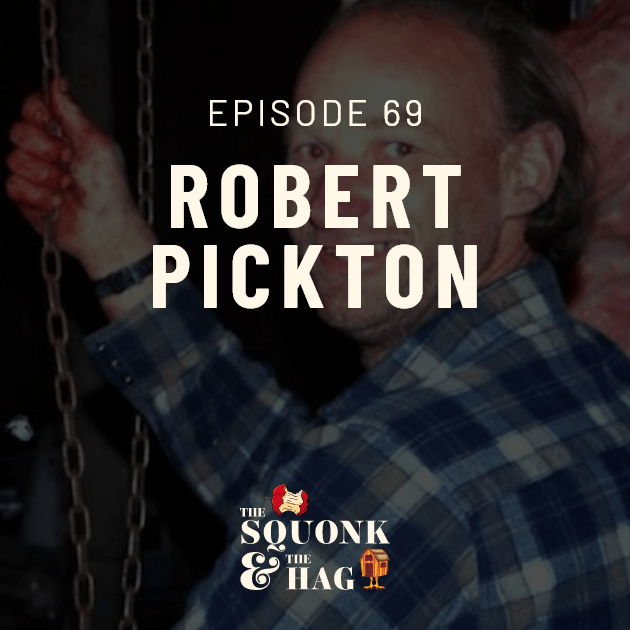
This episode’s story is actually the inspiration behind my favorite Criminal Minds story from Season 4. The two part episode includes episodes “To Hell…” and “…And Back”. Port Coquitlam is a charming suburb of Vancouver in Canada’s western province of British Columbia. While the population nowadays is around 65,000, the area was much more rural in 1949 when Leonard and Louise Pickton welcomed their middle child, Robert, into the world.
Their oldest child, a daughter named Linda was sent to live with family in Vancouver as the Pickton’s believed a pig farm was “an inappropriate place to raise a girl.” Robert and his younger brother Dave were raised on the farm.
Often, the boys were sent to school dirty and smelling of pig manure from their hard work on the farm, and this led to classmates giving them the nickname “Stinky Piggy” along other teasing. Leonard was an abusive father so Robert became strongly attached to his mother while having little interaction with his father.
Robert struggled in school, even being put in a special class after he failed the second grade. He ended up failing the second grade twice and the third grade. He eventually dropped out of school and worked as a meat cutter before returning to the family farm to work full time in 1963. In Robert’s audio diary, he said “We lived a good life, but we lived a hard life.”
In 1994, the Pickton children inherited the farm. The parceled out quite a bit of the 40 acre property and sold these parcels to land developers. Within a year, they made millions. Robert and Dave stayed on the land they kept.
As their financial situation improved, friends and family came out of the woodwork asking for money, lodging, drugs, cars, and other free handouts from the Pickton boys. Their friend Lisa Yelds says that they were taken advantage of as they gave substantial loans and gifts to people.
In 1997 alone, over 12 women disappeared from Vancouver’s eastside. Constable Dave Dickson was used to the transient community of the area coming and going, but 1997 was noticeably different. Started compiling a list of names and keeping track of if they were getting their social services checks, and many were no longer picking up their funds.
And more women continued to disappear. But most police gave the cases little attention due to the high risk lifestyles of the victims. Because they were drug addicts and sex workers, it was believed they just moved on to another city.
In June of 1998, Constable Dickson took a list of over 30 missing women to his superior. The case was then passed to Detective Inspector Kim Rossmo, a specialist in statistical analysis and serial killers. He didn’t believe these women were just missing. The statistics of missing women from the previous decades compared to the 1990s was statistically significant. Statistical significance means that the results of a set of data is not explainable simply by chance, but rather attributed to a specific cause. In this case, that was someone abducting and most likely killing these women.
The dramatic spike started in 1995 and continued to trend dramatically higher in 1997 and 1998. However, with no crime scenes, victim bodies or evidence, the department’s official opinion was that there was not enough evidence of a serial crime.
A crime that wasn’t attributed to these missing person cases at the time was an incident involving a sex worker that went by the name “Stitch”. Her identity was later released as Wendy Lynn Eistetter. Robert Pickton picked her up at the corner of Cordova Street and Princess Avenue in Vancouver’s East side.
On the farm, Pickton took her to his trailer and led her to a backroom. Inside was a giant roll of clear plastic and a sleeping bag. After sex, Stitch was looking in the phonebook for a number when Pickton came up behind her and placed a handcuff on her left wrist. Soon a struggle ensued and Stitch reached for a kitchen knife. During the fight, Stitch was stabbed four times: twice in the abdomen, once in the ribcage puncturing a lung, and once in the left arm. Pickton was slashed across the chest and throat.
Stitch was able to exit the trailer and stumble down the driveway. A couple driving down the road saw her still holding the knife with the handcuff on her wrist and bleeding profusely. An ambulance was called and Stitch was taken to the nearby hospital. She had lost almost 3 liters of blood and was rushed into surgery.
Pickton managed to drive himself to the same hospital where he told the medical staff that he had picked up a hitchhiker and they attacked him. But within his belongings, they found a key to a pair of handcuffs . . . and when taken to the operating room, they fit the ones on Stitch’s wrist.
Pickton lawyered up and refused to talk. On April 8, 1997, he was arrested for attempted murder, assault with a weapon and forcible confinement before being released on $2,000 bail.
Unfortunately, the charges were stayed on January 17, 1998. Stitch was considered an unreliable witness and unfit to testify due to her heavy drug use both during the attack and the trial preparation. However, police kept Pickton’s clothing in evidence.
The farm slowly transformed from a functional farm to a party destination. The Pickton brothers converted a slaughterhouse on the property to hold raves and wild parties. These events attracted as many as 2,000 people including sex workers, drug addicts and even members of the Hells Angels. After their 1998 New Years Eve party, the brothers were legally banned from future parties on the property.
On February 6, 2002, police executed a search warrant at the farm for illegal firearms, but instead found personal items belonging to some of the missing women from Vancouver. By February 22, Robert Pickton was charged with his first two counts of murder in the deaths of Sereena Abotsway and Mona Wilson. Both women had disappeared in 2001.
Police continued to comb through the farm and by April 2, three more murder charges were added for Jacqueline McDonell, Dianne Rock, and Heather Bottomley. Soon, charges for the murders of Andrea Joesbury and Brenda Wolfe were added. By October, the count came to fifteen murders including Georgina Papin, Patricia Johnson, Helen Hallmark, Jennifer Furminger, Heather Chinnock, Tanya Holyk, Sherry Irving and Inga Hall.
By May 26, 2005, twelve more charges were added for Cara Ellis, Andrea Borhaven, Debra Lynne Jones, Marnie Frey, Tiffany Drew, Kerry Koski, Sarah de Vries, Cynthia Feliks, Angela Jardine, Wendy Crawford, Diana Melnick, and Jane Doe bringing the total to 27 charges.
Forensic analysis was difficult because of the state of the bodies. After their deaths, they were left to decompose in the pig pens. Time, insects and pigs reduced the bodies to scraps.
After Pickton’s arrest, Lynn Ellinsen came forward with accounts of seeing Pickton hang a woman from a meat hook and skin the body years earlier. She said she kept the secret out of fear for her life, but on more than one occasion, she blackmailed Pickton regarding the event.
Police withdrew Pickton’s clothing from the 1997 arrest for Stitch’s attempted murder and tested the items. DNA for two of these women was found.
An undercover officer was placed with Pickton under the guise of being a cellmate. Pickton told him that he was disappointed he only killed 49 instead of an “even 50”.
On December 9, 2007, Pickton was convicted of second-degree murder for Sereena Abotsway, Mona Wilson, Andres Joesbury, Brenda Wolfe, Georgina Papin and Marnie Frey. The other charges were stayed. The differences between first and second degree murder are often about premeditation and the level of violence.
British Columbia Crown spokesman Neil MacKenzie announced the stayed charges. “In reaching this position,” he said, “the branch has taken into account the fact that any additional convictions could not result in any increase to the sentence that Mr. Pickton has already received.”
Pickton is currently serving a sentence of life imprisonment without possibility of parole.
| Victim | Age | Missing | Charge |
|---|---|---|---|
| Mary Ann Clark | 25 | Aug 1991 | Implicated |
| Jane Doe | Feb 25 1995 | Accused | |
| Diana Melnick | 23 | Dec 1995 | Accused |
| Tanya Holyk | 23 | Nov 3, 1996 | Accused |
| Cara Louise Ellis | 25 | Jan 21, 1997 | Accused |
| Sherry Leigh Irving | 24 | Feb 22, 1997 | Accused |
| Andrea Fay Borhaven | 25 | Mar 1997 | Accused |
| Helen Mae Hallmark | 20 | Jun 15, 1997 | Accused |
| Cynthia “Cindy” Feliks | 43 | Dec 1997 | Accused |
| Marnie Lee Anne Frey | 24 | Dec 29, 1997 | Convicted |
| Kerry Lynn Koski | 38 | Jan 7, 1998 | Accused |
| Inga Monique Hall | 46 | Feb 1998 | Accused |
| Sarah Jean de Vries | 29 | Apr 1998 | Accused |
| Angela Rebecca Jardine | 27 | Nov 20, 1998 | Accused |
| Jacquelene Michelle McDonell | 22 | Jan 16, 1999 | Accused |
| Wendy Crawford | 43 | Dec 1999 | Accused |
| Jennifer Lynn Furminger | 28 | Dec 27, 1999 | Accused |
| Tiffany Louise Drew | 27 | Dec 31, 1999 | Accused |
| Brenda Ann Wolfe | 32 | Apr 25, 2000 | Convicted |
| Dawn Teresa Crey | Dec 2000 | Implicated | |
| Debra Lynne Jones | 42 | Dec 2000 | Accused |
| Patricia Rose Johnson | 25 | Jan 2, 2001 | Accused |
| Georgina Faith Papin | 34 | Mar 2001 | Convicted |
| Yvonne Marie Boen | 33 | Mar 16, 2001 | Implicated |
| Heather Gabrielle Chinnook | 30 | Apr 2001 | Accused |
| Heather Kathleen Bottomley | 27 | Apr 17, 2001 | Accused |
| Andrea Joesbury | 22 | Jun 8, 2001 | Convicted |
| Sereena Abotsway | 29 | Aug 22, 2001 | Convicted |
| Mona Lee Wilson | 26 | Nov 30, 2001 | Convicted |
| Dianne Rosemary Rock | 34 | Dec 13, 2001 | Accused |
Sources
- https://en.wikipedia.org/wiki/Robert_Pickton
- https://allthatsinteresting.com/robert-pickton
- https://thecrimewire.com/true-crime/Robert-Pickton-The-Pig-Farmer
- https://crimejunkiepodcast.com/serial-killer-robert-william-pickton/
- https://www.thecanadianencyclopedia.ca/en/article/robert-pickton-case-plain-language-summary
- https://m.youtube.com/live/hKBaJN3gWhs
- https://www.narcity.com/where-robert-pickton-is-now-whats-happened-since-pig-farm-raided-2002
- https://serialkillersinfo.com/documents/serial-killer-robert-pickton-police-interview-transcript/
- https://www.scribd.com/document/35491483/Portion-of-Robert-Pickton-Jail-Cell-Transcript
- https://nationalpost.com/news/canada/pickton-interview-transcripts-released
- https://youtu.be/hU7y6wpD7ZQ?si=qOI0gOOjxJ6dF1kl
- https://www.theglobeandmail.com/news/british-columbia/woman-survived-pickton-attack-by-cutting-his-jugular-court-heard/article1377539/
- The Pig Farm, 2011 documentary
 The Squonk & The Hag Podcast: True Crime & Scary Stories